How to Create a Personal Development Plan: 30-Day Guide
·
Updated: January 27, 2026
·7 min read
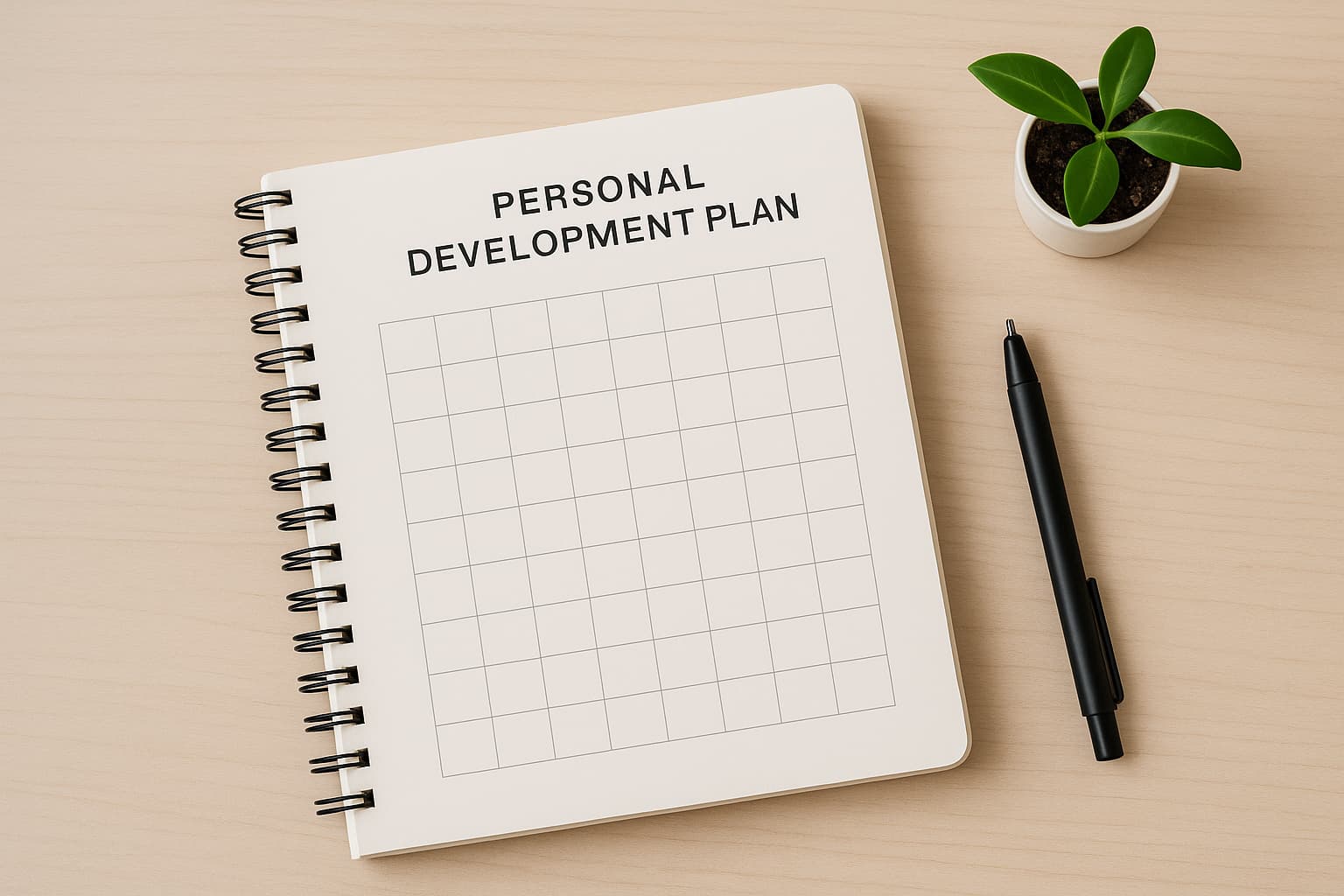
I used to be the king of abandoned goals.
Every January, I'd write down ambitious plans. Learn Spanish. Exercise daily. Read 50 books. Write a blog. By February? The notebook was collecting dust, and I was back to my old routines, feeling like a failure.
Sound familiar?
Then I discovered something that changed everything: I didn't need better goals—I needed a better system.
This guide will show you exactly how to create a personal development plan that actually works. Not a complicated 50-page document, but a simple one-page system you can start today and follow for the next 30 days.
Let's build yours together.

Fix: Shrink the input until it feels almost too easy. That's the sweet spot. Vague goals
Fix: Separate outcome (result you want) from input (action you control). Focus on inputs. Tool chasing
Fix: Use ONE tracker for 30 days. No new apps until you finish the cycle. Skipping weekly reviews
Fix: Put it on your calendar right now. Reflection multiplies learning. All-or-nothing thinking
Fix: Define a minimum. 5 minutes counts. Never miss twice.
Usually 2-3 weeks to feel momentum, 8-12 weeks for meaningful outcomes. You're building capacity, not chasing quick fixes. What if I miss a day?
Do the 5-minute minimum right now. Then show up tomorrow. The rule is never twice. Paper or digital tracker?
Whichever you'll actually open daily. Many people prefer printed pages they can see at a glance. What about motivation?
Motivation follows action, not the other way around. Make the first step tiny so action becomes inevitable. Can I work on multiple goals?
Start with one. Once it's automatic (usually 60-90 days), add another. Patience wins.
Why Most Personal Development Plans Fail
Before we build your plan, let's talk about why most fail. I've made all these mistakes myself: 1. Too many goals at once. We try to transform everything simultaneously. Spoiler: it doesn't work. Your willpower is finite. 2. Focusing on outcomes, not systems. "Lose 10kg" is an outcome. "Walk 20 minutes after lunch" is a system. You control systems; outcomes are just results. (I wrote more about this in How to Turn Goals into Systems.) 3. No feedback loop. Without tracking and weekly reviews, you're flying blind. 4. Starting too big. "Exercise for 1 hour daily" sounds great until day 3 when you're exhausted. Then you quit entirely. The solution? A framework built on four principles: Clarity, Low Friction, Feedback, and Cadence.The Science Behind This Personal Development Plan
This isn't just my opinion—it's backed by research. Implementation intentions (the "If X, then Y" format) make follow-through significantly more likely. When you pre-decide what you'll do in a specific context, your brain treats it almost like an automatic response. (Source: APA Research) The progress principle shows that visible daily progress is one of the most powerful motivators. Small wins create momentum. (Source: Harvard Business Review) That's why tiny, trackable steps beat heroic bursts every single time.How to Create Your Personal Development Plan (Step-by-Step)
Grab a piece of paper or open a note. We're going to fill this out together.Step 1: Define Your 90-Day Outcome
Write ONE specific result you want in 90 days. Not five. One. Good examples:- "Publish 8 blog posts"
- "Walk 120 km total"
- "Complete an online course"
- "Build a portfolio website"
- "Get healthier" (too vague)
- "Learn everything about marketing" (too broad)
- "Be more productive" (not measurable)
Step 2: Choose Your Daily Input
This is the secret sauce. Your daily input is the smallest action that guarantees progress. If you do the input, progress is automatic. No debates, no decisions. Examples:- Outcome: Publish 8 posts → Daily input: "25 minutes of writing before 9 AM"
- Outcome: Walk 120 km → Daily input: "20-minute walk after lunch"
- Outcome: Learn Spanish → Daily input: "15 minutes on Duolingo with morning coffee"
Step 3: Remove Friction
Every obstacle between you and your daily input is friction. Remove it ruthlessly. Practical moves:- Lay out your tools the night before
- Put your phone in another room
- Pre-write the first sentence/step
- Block time on your calendar (like a meeting with yourself)
Step 4: Set Up Your Tracker
Paper works beautifully. One box per day, one checkmark per completed session. Keep it visible—where your eyes land first thing in the morning.Step 5: Plan Your Weekly Review
Once a week (I do Sundays), spend 15-30 minutes answering four questions:- What worked this week?
- Where did I feel friction?
- What will I ship/complete next week?
- Do I need to adjust my daily input?
Your 30-Day Personal Development Challenge
Here's exactly what to do each week:Week 1: Clarity & Setup
- Choose your one outcome and one tiny daily input
- Set up your environment (remove friction)
- Write your "If [time/place], then I will [action]" statement
- Start tracking with visible checkmarks
- Complete at least 5 sessions
Week 2: Friction Hunt
- Identify your top 3 friction points
- Remove at least one friction per day
- Add a "5-minute minimum" rule for tough days
- Share your progress with one person (accountability helps)
Week 3: Feedback & Micro-Outputs
- Ship one small deliverable mid-week (outline, draft, demo)
- Ask someone for one specific suggestion
- Review your metrics—are you hitting 5 sessions/week?
- Keep daily input the same; improve the setup
Week 4: Cadence & Confidence
- Maintain your rhythm—don't scale too fast
- Add one small stretch (5 extra minutes, or share publicly)
- Celebrate your consistency
- Plan your next 30-day cycle
The 3 Metrics That Actually Matter
You don't need 19 dashboards. Track only these three numbers:1. Sessions Per Week (Target: 5)
A "session" = your daily input completed. Count completions, not minutes.2. Friction Removed Per Week (Target: 1)
Each week, change one thing that makes next week easier.3. Micro-Outputs Per Week (Target: 1-3)
Small deliverables prove movement: a paragraph, a workout, a draft outline. How to use these numbers:- Sessions dropping? → Shrink your daily input
- Friction staying high? → Fix the biggest blocker
- No micro-outputs? → Make deliverables smaller
Real Personal Development Plan Examples
Writing Goal
- Outcome (90 days): Publish 8 blog posts
- Daily input: 25 minutes of drafting before 9 AM
- Friction removed: Phone in another room; first sentence pre-written
- Weekly micro-output: One outline + one published paragraph
Fitness Goal
- Outcome (90 days): Walk 120 km total
- Daily input: 20-minute walk after lunch
- Friction removed: Shoes by the door; route preset in maps
- Weekly micro-output: 3 tracked walks minimum
Career Goal
- Outcome (90 days): Launch updated portfolio
- Daily input: 25 minutes of editing case studies
- Friction removed: Calendar blocks Tue/Thu; tabs pre-opened
- Weekly micro-output: One project page completed
Common Personal Development Plan Mistakes (And How to Fix Them)
Starting too bigFix: Shrink the input until it feels almost too easy. That's the sweet spot. Vague goals
Fix: Separate outcome (result you want) from input (action you control). Focus on inputs. Tool chasing
Fix: Use ONE tracker for 30 days. No new apps until you finish the cycle. Skipping weekly reviews
Fix: Put it on your calendar right now. Reflection multiplies learning. All-or-nothing thinking
Fix: Define a minimum. 5 minutes counts. Never miss twice.
Frequently Asked Questions
How long until I see results?Usually 2-3 weeks to feel momentum, 8-12 weeks for meaningful outcomes. You're building capacity, not chasing quick fixes. What if I miss a day?
Do the 5-minute minimum right now. Then show up tomorrow. The rule is never twice. Paper or digital tracker?
Whichever you'll actually open daily. Many people prefer printed pages they can see at a glance. What about motivation?
Motivation follows action, not the other way around. Make the first step tiny so action becomes inevitable. Can I work on multiple goals?
Start with one. Once it's automatic (usually 60-90 days), add another. Patience wins.
Your Next Steps (Start Today)
Here's what I want you to do right now:- Fill out your one-page plan (2 minutes)
- Block a 20-minute session for tomorrow morning
- Write your "If X, then Y" statement
- Do the first 90-second step right now—open the doc, name the file, write the title
Was this article helpful?
Related Posts
Mindset· 12 min
How to Build Measurable Progress in Personal Development
Build a personal development plan with clear milestones and tracking. Practical framework to measure real progress across any skill or goal.
Read

Mindset· 10 min
How to Turn Goals into Systems
Stop chasing goals that fail. Learn to build daily systems with clear inputs you control. Transform vague ambitions into visible, stress-free progress.
Read

Productivity· 8 min
How to Beat Procrastination: A Practical Guide That Actually Works
Finally beat procrastination with a system that works. Learn the science behind why we delay, plus 7 practical tactics to start taking action today.
Read
Mindset· 8 min
7 Books That Permanently Changed How I Think and Work
Not a reading list—these are the 7 books that rewired how I approach decisions, habits, focus, and learning. Each one left a permanent mark on my daily behavior.
Read
Explore more topics: